If you exfoliate and your skin glows for a day, then returns to looking flat by the end of the week, that pattern is telling you something. Exfoliation removed the older cells from the surface. The skin replaced them with more older cells. The rate of renewal how quickly fresh cells reach the surface to begin with — did not change. That is the actual problem, and no amount of product applied to the surface addresses it.
What dullness actually is
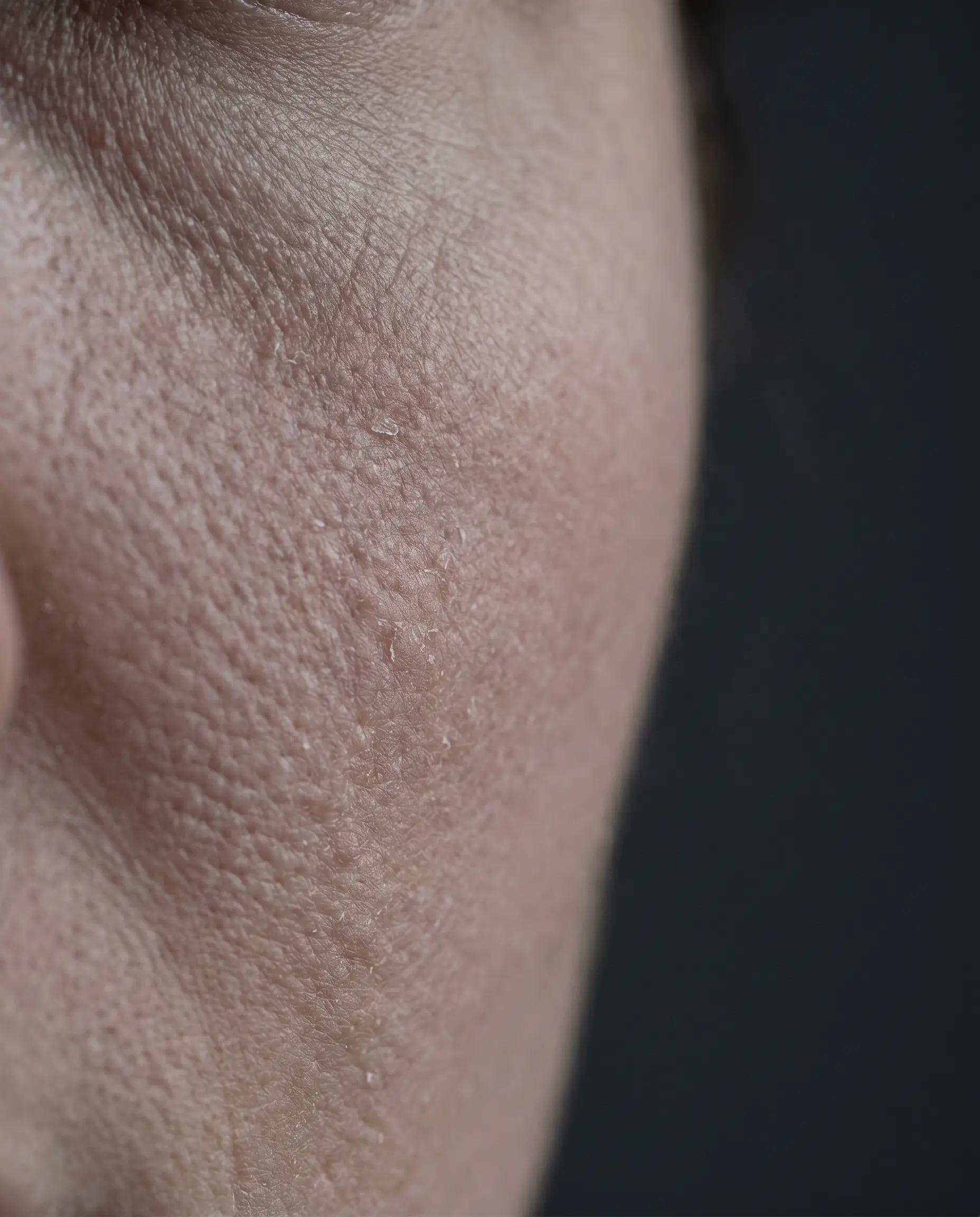
Dullness is not a skin type. It is a surface quality determined by two things happening at the cellular level. The first is how fresh the outermost skin cells are. The stratum corneum, the outermost layer, is made of dead cells called corneocytes. As they age on the surface, they become thicker, drier, and less translucent. Skin with a fast renewal rate replaces these cells quickly, so the surface is almost always young. Skin with a slow renewal rate holds onto older cells longer, and the result is a flat, opaque, greyish surface that reflects light poorly.
The second factor is the integrity of the barrier lipid layer beneath those cells. When the lipid matrix made primarily of ceramides, fatty acids, and cholesterol is compromised, the barrier scatters incoming light rather than allowing it to pass through and reflect back from the living tissue underneath. Healthy skin has a subtle translucency that gives it luminosity. Disrupted barrier skin does not.
Most products work on one of these two factors temporarily. The problem is neither factor is primarily a product problem. Both are governed by what happens while you sleep.
What products actually do and why the effect does not last
Where the renewal rate is actually set
The rate at which new skin cells are produced in the basal layer and migrate outward to eventually replace the corneocytes on the surface is regulated by the skin's circadian clock. Keratinocyte cell division peaks between roughly 1am and 3am, gated to the overnight window by the same internal clock that governs every other repair process in the body.1 This timing exists because dividing cells are more vulnerable to UV-induced DNA damage, and the clock schedules division to the safest possible window when UV exposure is absent.
When the circadian system is disrupted by evening light delaying melatonin, by inconsistent sleep timing, by chronic stress elevating cortisol through the evening the amplitude of this renewal process is reduced. The clock still runs, but with less precision and less intensity. Fewer new cells are produced per night. The surface accumulates older cells faster than it replaces them. The skin looks flat regardless of what is applied to it.
The same disruption that reduces renewal rate also compromises barrier lipid secretion, which as described earlier determines whether the barrier scatters light or allows it through. Both the renewal problem and the barrier problem have the same upstream cause: a circadian system that is not running the overnight repair programme at full intensity.
What actually addresses it
The upstream levers are the light environment in the evening (which determines whether the melatonin signal arrives on time to open the repair window), sleep timing consistency (which determines how reliably the cell division phase runs at its peak), and the ingredients that support the renewal machinery — niacinamide, which replenishes the NAD+ that powers the cell division and barrier repair processes, and barrier-supporting ingredients at night that work with the secretion the skin is attempting to run.2
The result is not immediate. It takes weeks rather than days because the improvement comes from a faster renewal cycle, not from surface removal. But it does not reverse. A surface that is consistently producing fresher cells and a barrier that is consistently replenishing its lipid layer will hold the improvement rather than cycling back to flat by Friday. The overnight timeline in this journal covers the full repair sequence these processes belong to.
- Dullness has two causes: older, thicker corneocytes sitting on the surface too long, and a compromised barrier lipid layer that scatters light instead of allowing it through. Both are determined by what happens overnight, not by what is applied to the surface.
- Exfoliants, brightening serums, and vitamin C work on the surface of these problems. They temporarily improve the appearance without changing the renewal rate or barrier function that will produce the same dullness again within days.
- Keratinocyte cell division peaks between 1am and 3am, governed by the skin's circadian clock. Evening light exposure, irregular sleep timing, and chronic cortisol elevation all reduce the intensity of this renewal phase.
- The upstream intervention is the light environment and sleep timing conditions that allow the circadian clock to run the renewal programme at full intensity overnight. Niacinamide supports this by replenishing NAD+, the energy cofactor the renewal and repair processes run on.
- Geyfman M, Kumar V, Liu Q, et al. Brain and muscle Arnt-like protein-1 (BMAL1) controls circadian cell proliferation and susceptibility to UVB-induced DNA damage in the epidermis. Proc Natl Acad Sci USA. 2012;109(29):11758–11763.
- Benavente CA, Jacobson MK, Jacobson EL. NAD in skin: therapeutic approaches for niacinamide and beyond. Mutat Res. 2012;746(2):107–116.